




Bend-Insensitive Fiber Optic Cable Vs Standard Fiber Cable: Which Is Better For Tight-Routing Applications?
 Sep 14, 2026|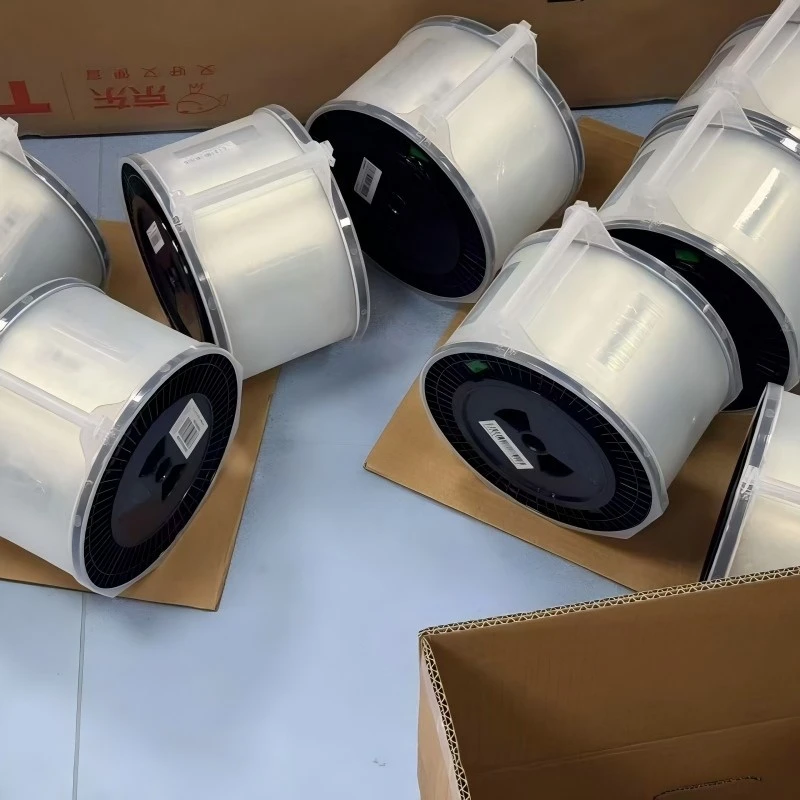
The Core Difference: How Each Fiber Handles a Bend
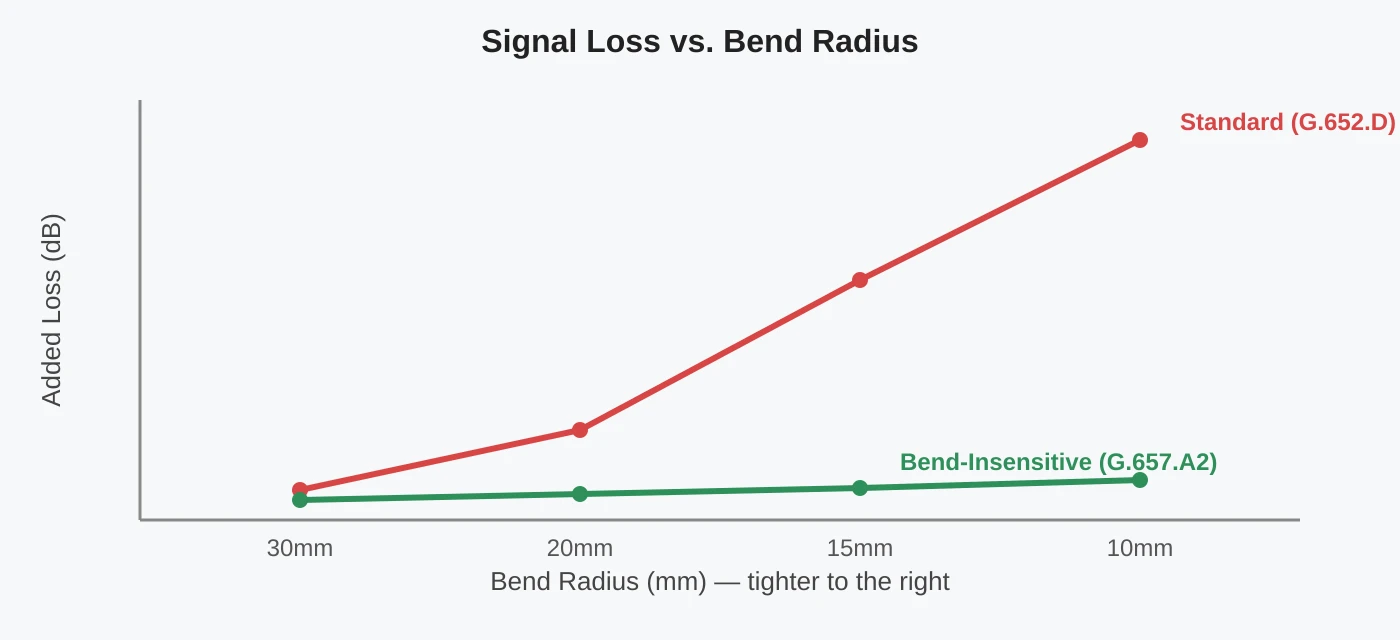
Standard single mode fiber, typically ITU-T G.652.D, is designed for long, relatively straight runs - backbone links, campus trunks, outdoor plant. Its core-cladding structure transmits light efficiently over long distances, but once the bend radius drops below roughly 30mm, macrobend loss increases sharply, and attenuation at 1550nm can jump enough to degrade the link or trip alarms on sensitive optical equipment.
Bend-insensitive single mode fiber, classified under ITU-T G.657 (commonly G.657.A1 or the tighter-tolerance G.657.A2), uses a modified refractive index profile - often a trench or ring design around the core - that traps light even when the fiber is bent to a 10mm or even 7.5mm radius with minimal added loss. This is the fiber behind most modern FTTH drop cables, indoor riser cables, micro-duct cables, and increasingly, data center patch cords and MPO trunk assemblies.
Quick Comparison
| Feature | Standard Single Mode (G.652.D) | Bend-Insensitive (G.657.A1/A2) |
|---|---|---|
| Minimum bend radius | ~30mm typical | 7.5–10mm typical |
| Macrobend loss at tight radius | High, unpredictable | Very low, stable |
| Best use case | Long-haul backbone, straight outdoor runs | In-building risers, FTTH drops, congested cabinets, data center racks |
| Compatibility with standard SM equipment | Full | Full (fully backward compatible) |
| Typical cost | Lower | Slightly higher, currently tightening in supply |
A Real Routing Problem: Why This Matters More in 2026
This is not a theoretical debate anymore. In January 2026, Corning and Meta signed a multi-year supply agreement worth up to USD 6 billion for optical fiber, cable, and connectivity products tied directly to Meta's AI data center expansion, including a major capacity build in North Carolina. The reason hyperscalers are locking in supply years ahead is that AI GPU clusters require dramatically more fiber connections per rack than earlier cloud architectures, and most of that cabling has to route through dense, space-constrained rack manifolds and overhead trays where a 30mm bend radius simply does not fit.
The same underlying fiber grade, G.657.A2, has also become the material of choice for fiber-guided drone systems, where several hundred to over two thousand meters of tightly-wound, jam-resistant optical fiber are spooled onto a single unit. That pull, combined with FTTH drop cable demand and data center growth, has genuinely tightened global supply of bend-insensitive fiber through 2026, with longer lead times and less flexible allocation than in previous years.
A practical example from the field: a European system integrator retrofitting fiber connectivity into a pre-1990s office building for an FTTH rollout ran into exactly this issue. The riser shafts had multiple tight 90-degree turns with an effective bend radius under 15mm at several junction boxes. Standard G.652.D drop cable tested with over 1.5dB of added loss at those bends - enough to fail the link budget on longer floors. Switching to G.657.A2 bend-insensitive drop cable brought the same bends down to under 0.1dB of added loss, with no redesign of the conduit path required.
Which One Should You Choose?
- Choose bend-insensitive fiber (G.657.A2) if: you are routing through conduit bends under 20mm radius, working inside congested equipment cabinets or data center racks, running FTTH drops into apartment units, or installing micro-duct cable in tight building risers.
- Standard single mode fiber (G.652.D) is fine if: your run is a long, largely straight outdoor or backbone path with generous bend allowances, and cost per meter is the primary constraint.
- Mixed approach: many projects use standard single mode fiber for long trunk runs and bend-insensitive patch cords or drop cables only at the tight-routing points - cabinets, risers, and final drops - which balances cost against reliability.
Sourcing Single Mode Fiber Optic Cable Reliably
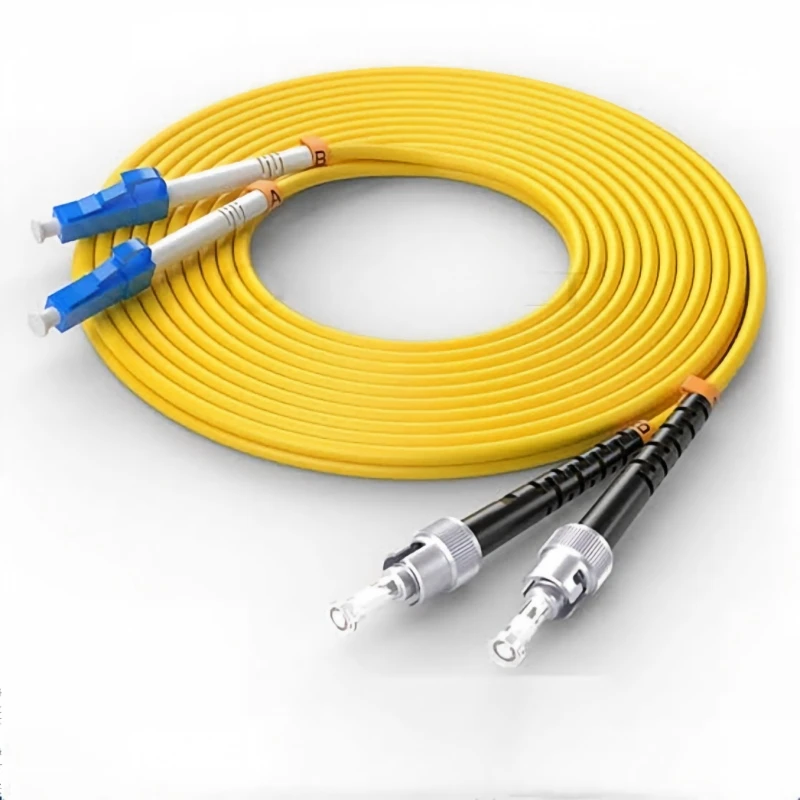
Given the current tightness in G.657.A2 supply, sourcing from a manufacturer that holds real inventory - rather than reselling on allocation - matters more than usual this year. China Super Tech Co., Ltd. maintains a large in-house stock of single mode fiber optic cable, including both standard G.652.D and bend-insensitive G.657.A1/A2 grades, in a full range of fiber counts, jacket types, and connector configurations, so standard specifications can ship quickly without waiting on a production slot. We also offer custom cable design - specific bend radius requirements, armored or micro-duct constructions, custom lengths, and factory pre-terminated assemblies - for projects that fall outside catalog specs.
Beyond fiber optics, China Super Tech Co., Ltd. is a diversified materials manufacturer producing titanium alloy, synthetic diamond, and niobium-tantalum products alongside our optical cable lines, giving industrial and telecom buyers a single, reliable supplier for multiple material and component needs rather than managing several vendors. Whether you need a standard single mode patch cable off the shelf or a custom bend-insensitive cable engineered around a specific routing constraint, our team can quote both directly from stock and from production.
If you are specifying cable for a project with tight routing, congested cabinets, or long-term supply risk, view our single mode fiber optic cable product range or submit an RFQ with your bend radius, fiber count, and length requirements, and we'll confirm stock availability and lead time.
Frequently Asked Questions
What is the difference between G.652 and G.657 fiber?
G.652 (including G.652.D) is standard single mode fiber optimized for long, straight-run transmission with a wider minimum bend radius, typically around 30mm. G.657 is bend-insensitive single mode fiber, built with a modified cladding design that allows bend radii as tight as 7.5–10mm with minimal signal loss, while remaining fully compatible with standard G.652 equipment and connectors.
Is bend-insensitive fiber optic cable more expensive than standard fiber?
Per meter, bend-insensitive fiber typically costs somewhat more than standard single mode fiber, and current global demand from AI data centers, FTTH programs, and specialty applications has tightened supply further in 2026. In practice, the price difference is usually small relative to the cost of a failed link, a re-pull, or ongoing attenuation problems at tight bends, which is why most in-building, riser, and data center cabling now defaults to bend-insensitive grades.