


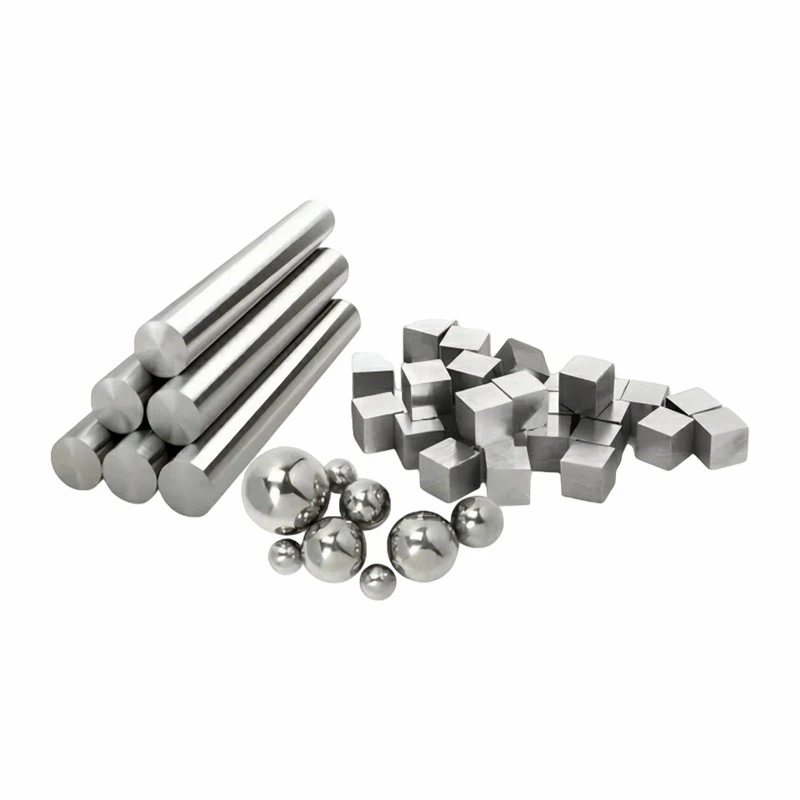
Tungsten Heavy Alloy WNiCu
Tungsten heavy alloy WNiCu is a high-density alloy material with tungsten as the matrix and nickel and copper as the bonding phases. Its significant advantage lies in its non-magnetic property, along with excellent thermal conductivity and electrical conductivity. It is widely used in precision instruments, electronic devices, electrical engineering, and special shielding scenarios that are sensitive to magnetism. It is an ideal alternative material to the traditional tungsten-nickel-iron (WNiFe) alloy.

- Product Introduction
Tungsten Heavy Alloy WNiCu
Tungsten heavy alloy WNiCu is a high-density alloy material with tungsten as the matrix and nickel and copper as the bonding phases. Its significant advantage lies in its non-magnetic property, along with excellent thermal conductivity and electrical conductivity. It is widely used in precision instruments, electronic devices, electrical engineering, and special shielding scenarios that are sensitive to magnetism. It is an ideal alternative material to the traditional tungsten-nickel-iron (WNiFe) alloy.
Product Features

1. Non-magnetic and Paramagnetic
This alloy does not contain iron and has no magnetic or paramagnetic properties at all, which is significantly different from tungsten-nickel-iron alloy. This characteristic ensures that it will not cause magnetic interference in strong magnetic field environments (such as magnetic resonance imaging equipment, satellite navigation systems), thus maintaining the accuracy of the equipment.
2. High Density and Mechanical Properties
The density range of this alloy is 16.5 to 18.75 grams per cubic centimeter, which is a typical high-density material, suitable for applications such as counterweights and inertial components. Its tensile strength reaches 700 to 1000 megapascals, although it is slightly lower than that of tungsten-nickel-iron alloy, it still meets the requirements for high strength.
3. Excellent Thermal Conductivity and Electrical Conductivity
The thermal conductivity is about 5 times that of tool steel, and the electrical conductivity is better than that of most tungsten alloys, suitable for scenarios requiring rapid heat/electricity conduction, such as heat sinks, electrical contacts, etc.
4. Low Thermal Expansion and Resistance to Thermal Shock
The thermal expansion coefficient is only 1/2 to 1/3 of that of steel or iron, ensuring excellent dimensional stability and the ability to withstand drastic temperature changes without deformation, suitable for extreme environments such as aerospace.
5. Excellent Radiation Shielding Capability
The shielding effect against X-rays and gamma rays is 30% to 40% higher than that of lead, combined with the non-magnetic characteristic, it becomes an ideal protective material for nuclear medicine, storage of radioactive sources, etc.
6. Processing Limitations
Copper has a relatively weak effect in the activation sintering process, resulting in a slightly lower sintering density than tungsten-nickel-iron alloy. This alloy usually does not require heat treatment or deformation processing, and the selection of forming process needs to be carefully made according to the application requirements.
Application
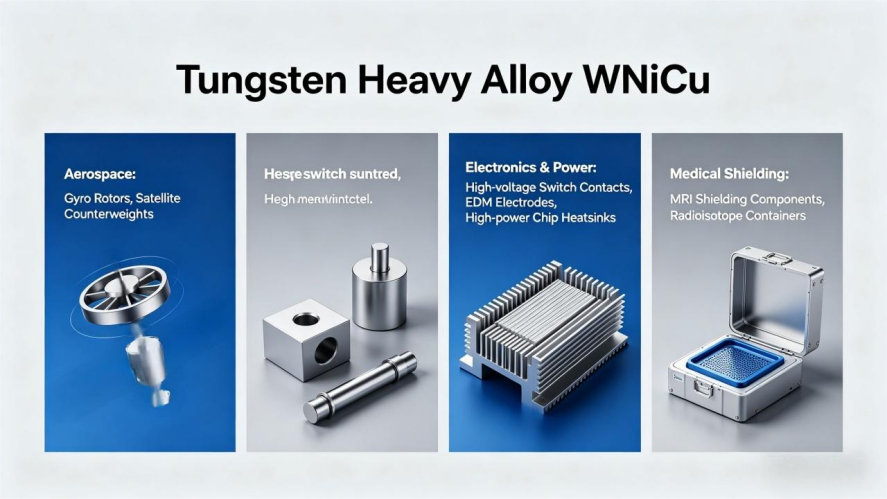
(1)Gyro rotor and inertial navigation system: Non-magnetic property to avoid magnetic field interference, ensuring navigation accuracy.
(2)Satellite counterweight: High-density balance satellite posture, low thermal expansion to adapt to space temperature changes.
2. Electronics and Power Industry
(1)High-voltage switch contacts: Resistant to arc erosion, excellent conductivity.
(2)Electrical discharge machining electrode: High-density to enhance processing efficiency, stable conductivity to ensure discharge stability.
(3)High-power chip heat sink: Rapid heat dissipation to extend chip lifespan, non-magnetic property to be compatible with electronic equipment.
3. Medical and Professional Shielding
(1)MRI shielding component: Shielding radiation without interfering with equipment magnetic field.
(2)Radioisotope container: High-density and strong shielding performance to ensure safe storage.
Specification
|
Item |
Specification |
|
Product Name |
Tungsten Heavy Alloy WNiCu |
|
Type |
W-Ni-Cu Alloy (High Density Tungsten Alloy) |
|
Tungsten Content |
85% – 97% (Typical range, customizable) |
|
Nickel Content |
1% – 7% |
|
Copper Content |
1% – 5% |
|
Density |
17.0 – 18.5 g/cm³ |
|
Hardness |
HRC 20 – 35 / HB 200 – 350 |
|
Tensile Strength |
600 – 1000 MPa |
|
Yield Strength |
500 – 900 MPa |
|
Elongation |
2% – 10% |
|
Thermal Conductivity |
80 – 120 W/m·K |
|
Electrical Conductivity |
Moderate (higher than W-Ni-Fe alloys) |
|
Melting Point |
≥ 3000°C (Tungsten phase) |
|
Magnetic Properties |
Non-magnetic or weakly magnetic |
|
Corrosion Resistance |
Good resistance to oxidation and corrosion |
|
Fabrication Methods |
Powder metallurgy (pressing & sintering), machining |
|
Surface Condition |
Sintered / Machined / Polished |
|
Available Shapes |
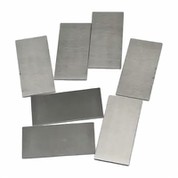
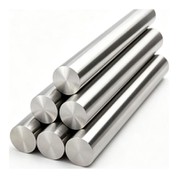
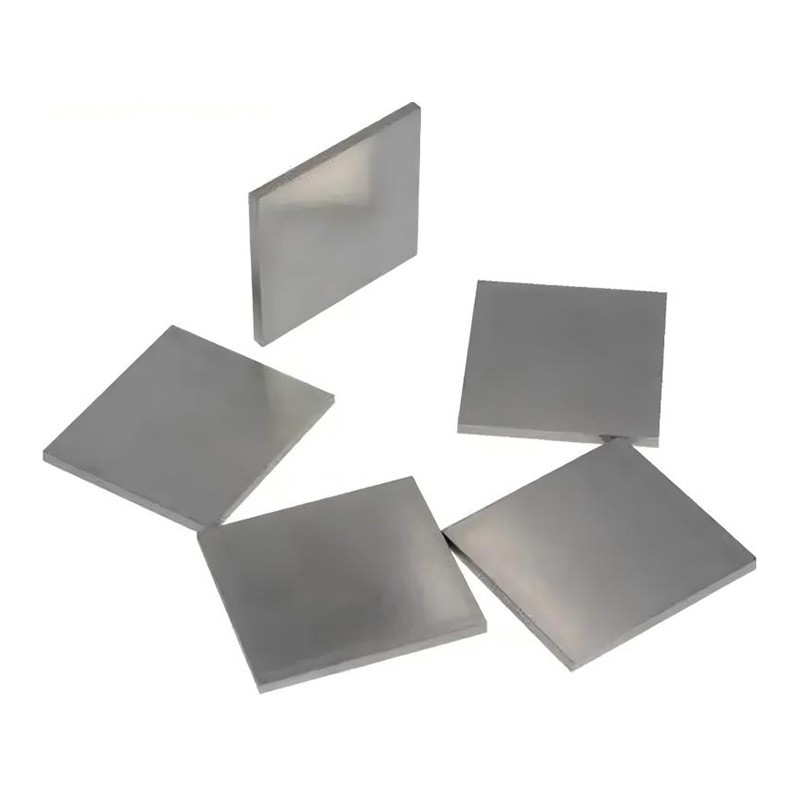
Rod / Plate / Block / Disc / Custom Parts |
|
Tolerance |
±0.1 mm – ±0.5 mm (depending on machining) |
|
Operating Temperature |
Up to 800°C – 1000°C (depending on environment) |
|
Applications |
Radiation shielding, counterweights, aerospace components, military parts, vibration damping |
|
Packaging |
Wooden Case / Carton / Custom Export Packaging |
|
Certification |
ISO / RoHS / CE (Optional) |
Customized Service

We offer customization services for the composition and dimensions of WNiCu alloy.
All products comply with ASTM B777-99 or GB/T 26038-2010 standards; material certificates and inspection reports are available upon request. We welcome inquiries regarding specific application requirements and will assist in optimizing material formulations and processing techniques to enhance product performance and cost-efficiency.
FAQ
1. What is Tungsten Heavy Alloy WNiCu?
It is a high-density alloy made primarily of tungsten with nickel and copper as binder metals, produced through powder metallurgy processes.
2. What is the typical composition of WNiCu alloy?
It generally consists of a high percentage of tungsten (usually above 85–95%), with the remainder being nickel and copper in varying ratios depending on required properties and application.
3. Why is copper added to tungsten-nickel alloys?
Copper is added to improve thermal and electrical conductivity, enhance sintering performance, and fine-tune mechanical properties such as ductility and corrosion resistance.
4. What are the key properties of WNiCu tungsten alloy?
Key properties include high density, excellent strength, good toughness, high wear resistance, and strong radiation shielding capability.
5. What is the density of WNiCu tungsten heavy alloy?
The density typically ranges from about 16 to 18 g/cm³, depending on tungsten content and manufacturing process.
6. How is WNiCu alloy manufactured?
It is produced using powder metallurgy: tungsten, nickel, and copper powders are blended, compacted into shape, and sintered at high temperatures to achieve full densification.
7. What are the advantages of WNiCu over pure tungsten?
Compared to pure tungsten, WNiCu offers better machinability, improved toughness, and reduced brittleness, making it easier to fabricate complex shapes.
8. What are common applications of WNiCu tungsten alloy?
Typical applications include counterweights, balancing weights, radiation shielding components, aerospace parts, defense components, and precision mechanical parts.
9. How does WNiCu compare to WNiFe alloys?
WNiCu generally offers better thermal conductivity and corrosion resistance, while WNiFe typically provides higher strength and is more commonly used in structural and impact-resistant applications.
10. Can WNiCu alloy be machined?
Yes, WNiCu alloys can be machined using conventional methods such as turning, milling, grinding, and EDM, though specialized tools may be required due to their high hardness.
Hot Tags: tungsten heavy alloy wnicu, China tungsten heavy alloy wnicu manufacturers, suppliers, factory