Molybdenum Heating Elements

Product Overview


Molybdenum heating elements provide high-temperature thermal processing under vacuum or protective reducing atmospheres up to 1800°C. Fabricated from powder-metallurgy molybdenum with a purity of >= 99.95%, these components combine a 2620°C melting point, low vapor pressure, and stable electrical resistivity at elevated temperatures.


Key Features

Controlled Recrystallization:

Processed through optimized swaging and thermal annealing schedules to balance mechanical strength and ductility post-initial thermal cycling, mitigating brittle fracture risks.

High Purity (>= 99.95%):

Limits trace metallic and gaseous interstitial impurities (C, O, N, H) to safeguard sensitive workloads and prevent outgassing in high vacuum (< 10^-3 Pa).

Precise Terminal Tolerances:

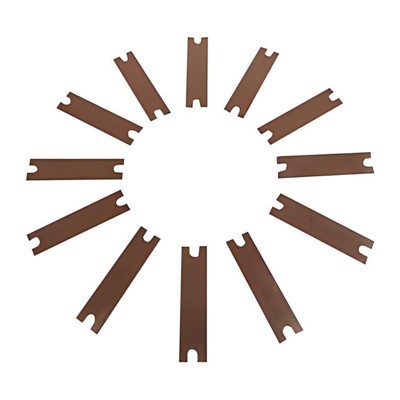
CNC-machined connecting straps, tabs, and mounting interfaces ensure uniform current flow and eliminate localized thermal hotspots at joints.

Versatile Geometries:

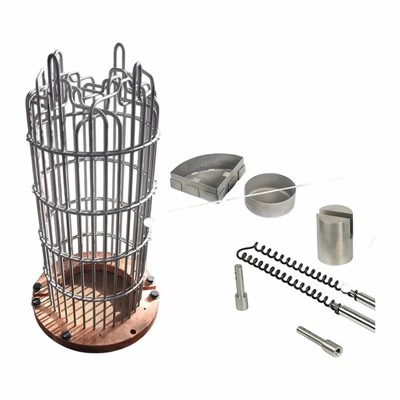
Engineered in mesh, hairpin (strip/rod), serpentine (zig-zag), and cylindrical cage configurations to match specific furnace hot zone volumes and power densities.


Technical Specifications


Parameter

Specification Details

Material Grades

Unalloyed Molybdenum (Mo >= 99.95%) / TZM Alloy (Mo-0.5Ti-0.1Zr-0.02C)

Purity

>= 99.95% (Low residual carbon and oxygen)

Max Operating Temp.

Up to 1600°C (Vacuum) / 1800°C (Inert Gas / H2)

Density

>= 10.2 g/cm^3 (Fully dense, worked powder metallurgy structure)

Available Forms

Strip, Rod, Wire, Sheet, Tube, and Complete Assembled Modules

Electrical Resistivity

5.35 x 10^-7 Ohm*m at 20°C (Linear temperature coefficient applies)

Dimensional Tolerances

Linear dimensions: +/- 0.1 mm; Cold resistance matching: +/- 3% per zone

Manufacturing Standards

ASTM B386 / ASTM B387, Ultrasonic and Eddy Current testing compliant


Typical Applications
Molybdenum Furnace Components

Vacuum Sintering:

Sintering tungsten carbide hardmetals, advanced technical ceramics, and powder metallurgy parts.

Cu Mo Cu Base Flange Heat Sink

Vacuum Brazing & Heat Treatment:

Aerospace component brazing, stainless steel bright annealing, and titanium stress relief.

Molybdenum Disilicide Heater

Sapphire Crystal Growth:

Resistance heating shields and core heating elements for Kyropoulos and HEM crystal growth furnaces.

Molybdenum Heater

Laboratory & R&D Furnaces:

High-temperature tube and box furnaces requiring rapid thermal cycling in controlled atmospheres.


OEM & Custom Engineering Services

We manufacture heating elements directly from customer blueprints, CAD models, or replacement samples.


Thermal Load Analysis:

Engineering review of surface watt loading (typically maintained at 4 to 8 W/cm^2 based on atmosphere) to prevent premature burnout.


Complete Hardware Assemblies:

Supplied with matching molybdenum nuts, bolts, washers, current feedthrough terminals, and high-purity alumina/mullite insulators.


Flexible Volume:

Single-piece drop-in replacements for emergency maintenance or serialized batch manufacturing for furnace OEMs.


Quality Control & Metrology

Reliable thermal performance requires metallurgical verification at every stage of production.

Raw Material Testing:

Chemical composition certified via ICP-OES analysis for every incoming lot of molybdenum powder and sintered billets.

Metallographic Analysis:

Optical microscopy to verify grain size and microstructural uniformity, preventing micro-cracks before forming.

Dimensional Verification:

100% inspection using coordinate measuring machines (CMM) and optical comparators for complex bends and hole spacings.

Cold Resistance Sorting:

Individual elements measured for baseline resistance (R20) and grouped within +/- 3% tolerances to guarantee balanced multi-phase circuit loads in the furnace hot zone.


Packaging & Shipping
Anti-Shock Protection:
Molybdenum becomes brittle after service, but unused elements require secure handling. Parts are secured in custom, high-density EPE foam cradles to prevent flexural stress.
Moisture Sealing:
Vacuum-sealed in anti-static polyethylene liners with active desiccants to prevent surface oxidation during transit.
Export-Grade Crating:
Packed in fumigation-free plywood boxes featuring internal structural bracing to eliminate shifting during international freight.


Frequently Asked Questions


Q: Can molybdenum heating elements be operated in air or oxidizing environments?

A: No. Molybdenum oxidizes rapidly above 400°C in air, forming volatile molybdenum trioxide (MoO3) vapor that leads to rapid element destruction. Operation is strictly restricted to high vacuum (< 10^-2 Pa), pure hydrogen, or inert shielding gases (argon/helium).

Q: How do you mitigate element sagging at temperatures exceeding 1500°C?

A: Sagging is controlled through optimized mechanical suspension design, adequate expansion clearance, and the use of TZM alloy (Molybdenum-Titanium-Zirconium) in high-stress or high-temperature structural zones. TZM offers higher recrystallization thresholds and superior creep resistance compared to unalloyed molybdenum.

Q: What is the recommended surface watt loading (W/cm^2) for strip elements?

A: For standard vacuum operations up to 1600°C, surface watt loading should generally be maintained between 4 W/cm^2 and 8 W/cm^2. Excessive loading accelerates vaporization rates and shortens service life; exact thresholds depend on vacuum levels and atmospheric purity.

Q: Can you replicate custom replacement elements from a damaged physical sample?

A: Yes. We accept both 2D/3D CAD models (STEP, IGES, PDF) and worn physical samples. Our engineering team evaluates current-carrying capacities, terminal interfaces, and dimensional tolerances to fabricate direct drop-in replacements matching original equipment standards.


modular-1
Request for Quote

To receive a precise technical proposal and quotation for your molybdenum heating elements, please provide the following parameters:
Drawings / Dimensions: CAD file, technical drawing, or sketch indicating strip thickness, width, length, bend radii, and terminal hole geometry.
Material Grade: Unalloyed Molybdenum (>= 99.95%) or TZM Alloy.
Operating Environment: Vacuum level, inert gas type, or reducing atmosphere (H2).
Operating Temperature: Maximum target temperature inside the hot zone.
Electrical Requirements: Operating voltage, current, and required power (kW) per element or zone.
Quantity: Prototype sample quantity or scheduled annual volume.

As one of the most professional molybdenum heating elements manufacturers and suppliers in China, we warmly welcome you to buy OEM molybdenum heating elements from our factory. All custom made products are with high quality and competitive price. Contact us for quotation.

Molybdenum Furnace Components, Molybdenum Heater, molybdenum heating elements

(0/10)

clearall