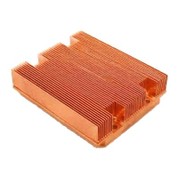


Cu Mo Cu Base Flange Heat Sink
The Cu Mo Cu Base Flange Heat Sink adopts a sandwich structure design. It uses molybdenum (Mo) or molybdenum-copper alloy as the core layer, with high-purity copper (Cu) layers covering the top and bottom. It features efficient heat dissipation, thermal expansion matching, and lightweight characteristics. It is specifically designed for the base or flange applications of high-power electronic devices, significantly enhancing the reliability of the devices and extending their service life.

- Product Introduction
Cu Mo Cu Base Flange Heat Sink
The Cu Mo Cu Base Flange Heat Sink adopts a sandwich structure design. It uses molybdenum (Mo) or molybdenum-copper alloy as the core layer, with high-purity copper (Cu) layers covering the top and bottom. It features efficient heat dissipation, thermal expansion matching, and lightweight characteristics. It is specifically designed for the base or flange applications of high-power electronic devices, significantly enhancing the reliability of the devices and extending their service life.
Product Features

1. Tailorable Thermal Expansion Coefficient (CTE)
(1) CMC (Cu/Mo/Cu):
The core layer is pure molybdenum (Mo), and the CTE can be precisely designed to match that of silicon chips (~4.2×10⁻⁶/K) or ceramic substrates, reducing the risk of solder joint cracking caused by thermal stress.
(2) CPC (Cu/MoCu/Cu):
The core layer is a molybdenum-copper alloy (such as Mo70Cu30), with a CTE of approximately 8.0×10⁻⁶/K. It balances both thermal conductivity and thermal compatibility, suitable for commercial high-power devices.
2. High Thermal Conductivity
The outer pure copper layer provides excellent in-plane heat diffusion capability, quickly conducting the local hotspots of the chip laterally to avoid local overheating.
The thermal conductivity of the CPC type can reach over 270 W/(m·K), meeting the requirements of high-frequency and high-power scenarios.
3. Resistance to Thermal Shock and High Reliability
The CMC type can withstand repeated thermal shocks at 850°C, with extremely high interface bonding strength, suitable for extreme environments such as aerospace.
The metallurgical bonding process (with a diffusion layer of approximately 0.7 μm) significantly improves thermal conductivity and thermal shock resistance, avoiding the performance degradation of low-end mechanical bonding products.
4. Lightweight Design
Compared to traditional tungsten-copper (WCu) materials, the density is reduced by approximately 40%, reducing the weight of the device, which is crucial for aerospace, portable devices, and other scenarios.
Application
Cu Mo Cu Base Flange Heat Sink is widely applied in the following fields, helping B-end customers enhance product performance and stability:
1. Wireless communication: Base heat sink for 5G base station power amplifiers (PA).
2. Optical communication: Heat management for laser diode (LD) mounts and optical module enclosures.
3. Aerospace: High-reliability heat dissipation for radar and satellite communication modules.
4. Industrial and medical: Cu Mo Cu heat sink for high-power semiconductor devices and medical equipment (such as laser treatment machines).

Specification
|
Item |
Specification |
|
Product Name |
Cu-Mo-Cu Base Flange Heat Sink |
|
Structure |
Cu / Mo / Cu laminated composite (sandwich structure) |
|
Outer Layer Material |
Oxygen-Free Copper (OFHC, ≥99.95%) |
|
Core Material |
Molybdenum (Mo ≥99.9%) or Mo alloy |
|
Bonding Method |
Diffusion bonding / hot pressing |
|
Density |
9.5 – 10.5 g/cm³ |
|
Thermal Conductivity |
180 – 250 W/m·K (effective) |
|
Cu Surface Conductivity |
350 – 390 W/m·K |
|
CTE (Thermal Expansion) |
6.5 – 10.5 × 10⁻⁶ /K (customizable) |
|
Operating Temperature |
-55°C to +300°C |
|
Flatness |
≤ 0.01 mm |
|
Parallelism |
≤ 0.01 – 0.03 mm |
|
Surface Roughness |
Ra ≤ 0.8 μm |
|
Machining Process |
CNC machining (5-axis optional) |
|
Flange Type |
Integrated / custom machined flange |
|
Hole Types |
Threaded / through / blind holes |
|
Thread Range |
M2 – M8 (custom available) |
|
Surface Treatment |
Ni plating / Au plating / Ag plating / passivation |
|
Thickness Range |
1.0 – 20.0 mm (custom up to 50 mm) |
|
Size Range |
5 – 300 mm (custom larger available) |
|
Thermal Cycling Life |
≥10,000 cycles |
|
Application |
RF / microwave / semiconductor / laser / aerospace |
Customized Service

China Super Tech offers a one-stop customized solution to meet the diverse needs of customers:
1. Material and structure customization: Adjust the composition and layer thickness ratio of molybdenum/molybdenum-copper alloy based on parameters such as chip CTE and power density.
2. Stamping molding service: Support integrated molding of complex flanges or bases to reduce assembly processes.
3. Surface treatment: Provide surface treatments such as nickel plating and gold plating to enhance corrosion resistance and welding compatibility.
4. Rapid prototyping and mass production: Relying on advanced processes and supply chain, shorten delivery cycle and support small-batch trial production and large-scale production.
China Super Tech is dedicated to providing global customers with high-performance heat dissipation material solutions. We welcome you to contact us for technical consultation and sample support to jointly optimize your product design!

FAQ
1. What is a Cu Mo Cu Heat Sink?
It is a laminated composite heat sink structure made of Copper–Molybdenum–Copper, designed to combine high thermal conductivity with low thermal expansion for high-power electronic applications.
2. Why use a Cu-Mo-Cu structure instead of pure copper?
Pure copper has excellent thermal conductivity but high thermal expansion. Cu-Mo-Cu reduces thermal expansion while maintaining good heat dissipation, improving reliability in electronic packaging.
3. What industries commonly use Cu Mo Cu heat sinks?
It is widely used in RF/microwave devices, semiconductor packaging, laser systems, aerospace electronics, radar systems, and high-power communication modules.
4. What is the thermal conductivity of Cu-Mo-Cu material?
The effective thermal conductivity typically ranges from 180 to 250 W/m·K, depending on structure design and layer ratio.
5. Can the thermal expansion (CTE) be customized?
Yes, the CTE can be adjusted between approximately 6.5 × 10⁻⁶ /K to 10.5 × 10⁻⁶ /K to match different ceramic substrates like AlN or Al₂O₃.
6. What surface treatments are available?
Common options include nickel (Ni) plating, gold (Au) plating, silver (Ag) plating, and anti-oxidation passivation treatment.
7. What is the maximum operating temperature?
Cu-Mo-Cu heat sinks can typically operate in a range from -55°C to +300°C depending on application conditions.
8. Can you machine custom flange designs?
Yes, CNC machining allows customization of flange shape, mounting holes, grooves, threads, and complex geometries.
9. What is the flatness tolerance of this product?
High-precision grades can achieve flatness within ≤ 0.01 mm, suitable for semiconductor and RF packaging requirements.
10. What are the main advantages of Cu-Mo-Cu heat sinks?
Key advantages include low thermal stress, high reliability, excellent heat spreading performance, strong mechanical stability, and long service life under thermal cycling.
Hot Tags: cu mo cu base flange heat sink, China cu mo cu base flange heat sink manufacturers, suppliers, factory, Cu Mo Cu Base Flange Heat Sink, Cu Mo Cu Heat Sink, Molybdenum Copper Heat Sink, Molybdenum Disilicide Heater, Molybdenum Element For Vacuum Furnace, molybdenum heating elements