Titanium Screws
We machine precision titanium screws specifically for high-load, high-precision plastic injection molds, hot runner systems, and semiconductor tooling.
Unlike conventional alloy steel or stainless steel fasteners, titanium fasteners deliver a targeted balance of low density (4.5 g/cm3, roughly 40% lighter than steel) and high tensile strength, paired with natural chemical passivation. They are engineered to solve specific operational failures in mold manufacturing, such as thread galling under thermal cycling, rust contamination in cooling channels, and fatigue breakage in high-frequency cycling plates.

- Product Introduction
Precision Titanium Screws for Plastic Injection Molds & Hot Runner Systems
We machine precision titanium screws specifically for high-load, high-precision plastic injection molds, hot runner systems, and semiconductor tooling.
Unlike conventional alloy steel or stainless steel fasteners, titanium fasteners deliver a targeted balance of low density (4.5 g/cm3, roughly 40% lighter than steel) and high tensile strength, paired with natural chemical passivation. They are engineered to solve specific operational failures in mold manufacturing, such as thread galling under thermal cycling, rust contamination in cooling channels, and fatigue breakage in high-frequency cycling plates.
Core Engineering Advantages in Mold Manufacturing
Elimination of Rust and Chemical Contamination
• Mechanism: Titanium naturally forms a tightly adherent titanium dioxide (TiO2) passivation layer instantaneously upon exposure to oxygen.
• Application Impact: In cleanroom injection molding (e.g., optical components, medical syringes, and pharmaceutical packaging), standard steel screws shed iron oxide over time due to moisture from mold cooling lines or aggressive flame-retardant polymer outgassing. Titanium screws eliminate rust debris, preventing particulate contamination in cavity plates and parting lines.
High Strength-to-Weight Ratio and Reduced Inertia
• Density Advantage: At 4.5 g/cm3 compared to steel's 7.85 g/cm3, titanium fasteners significantly reduce the dead weight of moving mold components.
• Application Impact: Applied on high-speed side-action slides, core-pulling mechanisms, and stack mold assemblies, lighter fasteners reduce mechanical inertia, lower driving forces on hydraulic/pneumatic cylinders, and minimize wear on guide pins and bushings during rapid opening and closing cycles.
Thermal Stability, Anti-Galling & Fatigue Resistance
• Behavior Under Thermal Cycling: Injection molds continuously cycle between injection temperatures (often 200°C to 350°C) and cooling water temperatures. While steel fasteners experience micro-structural fatigue and progressive preload loss due to differential thermal expansion rates, titanium grades maintain stable mechanical engagement.
• Surface Treatment & Anti-Galling: To prevent the natural tendency of titanium threads to cold-weld or gall during high-torque assembly, our fasteners can be treated with specialized anti-galling coatings or surface anodizing to ensure smooth, repeatable installation and removal.
• Fatigue Strength: Utilizing Grade 5 (Ti-6Al-4V), screws achieve a high strength-to-weight ratio with superior resistance to cyclic tensile and shear stresses, reducing the risk of snap-off inside deep mold plates.
Material Grade Selection
|
Grade Designation |
Typical Tensile Strength |
Recommended Mold Application |
|
Grade 2 (Commercially Pure Titanium, UNS R50400) |
>= 345 MPa |
Hot runner clamping plates, chemical-exposure auxiliary fixtures, and low-load covers where maximum corrosion resistance is prioritized over high tensile pull. |
|
Grade 5 (Ti-6Al-4V Alloy, UNS R56400) |
>= 895 MPa |
High-pressure injection mold core plates, moving slides, parting line locking mechanisms, and high-frequency clamping positions. |
Head Styles & Technical Configurations
All screws are produced via precision CNC multi-axis machining and thread rolling to maintain strict thread pitch accuracy and tolerance control (metrical tolerances conforming to ISO 6g).
Socket Head Cap Screws (DIN 912 / ISO 4762): Standard for high-clamp applications in split mold blocks and clamping plates where high torque transmission is required via hex keys.
Button Head Screws (ISO 7380): Low-profile dome head utilized in confined spaces on slide retainers or ejection plates where clearance is restricted.
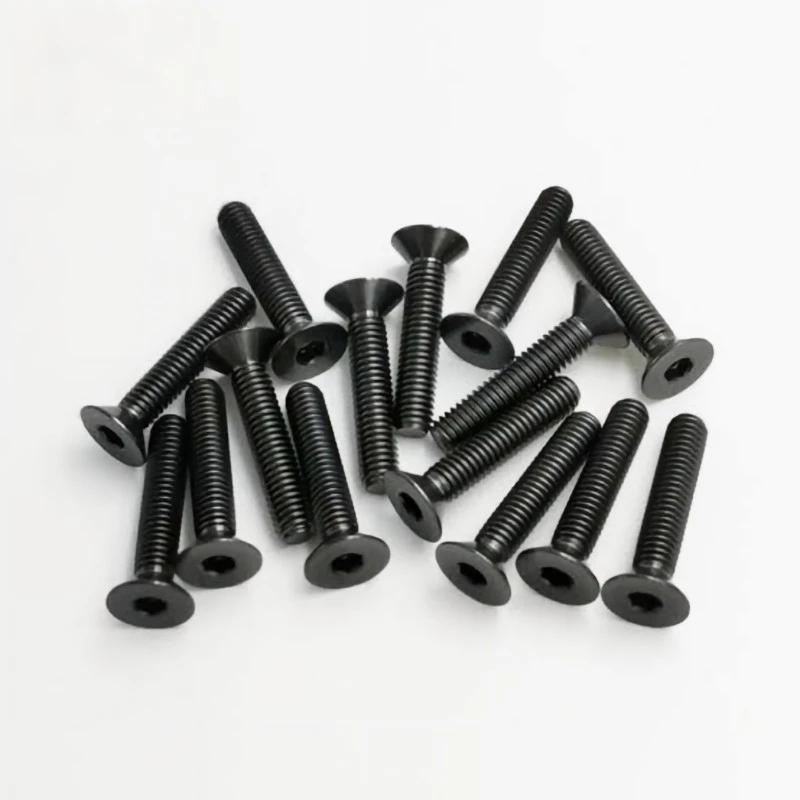
Flat Countersunk Head Screws (DIN 7991 / ISO 10642): Designed for flush-surface mounting on parting lines and sliding wear plates to prevent interference with machine platens.
Shoulder Screws: Precision-ground unthreaded shoulder sections manufactured to tight diameter tolerances, functioning as axis pivots for mechanical linkage bars and cam tracks in slider mechanisms.
Technical Specifications & Commercial Support
Standard Compliance: DIN, ISO, ANSI/ASME, JIS, or manufactured strictly per customer engineering drawings and CAD files.
Thread Range: Metric M1.6 through M12; Inch threads (UNC/UNF) available upon request.
Machining Tolerances: Linear dimensions down to +/- 0.02 mm, thread fit class 6g.
Quality Assurance: 100% incoming raw material spectrometer verification, optical comparator dimensional profiling, thread ring/plug gauge testing, and visual surface examination prior to batch packaging.
Flexible Commercial Support: Low minimum order quantities (MOQ) for custom prototypes, rapid sample turnaround, and reliable serial production lead times tailored to global supply chain schedules.
FAQ
Q: Are titanium screws suitable for plastic injection molds?
A: Yes. Titanium screws are ideal for plastic injection molds, especially applications requiring corrosion resistance, lightweight construction, and long service life. They are commonly used in precision molds, medical molds, electronic molds, and special engineering plastic applications.
Q: What titanium grade is best for mold screws?
A: Grade 5 titanium (Ti-6Al-4V) is commonly selected when high mechanical strength is required. Grade 2 titanium is chosen for applications requiring exceptional corrosion resistance and good formability. The best choice depends on your specific load requirements and operating environment.
Q: Are titanium screws stronger than stainless steel screws?
A: Titanium screws provide a superior strength-to-weight ratio compared to standard stainless steel screws. While certain high-alloy stainless steels have higher absolute strength by volume, titanium matches or exceeds them in strength while offering a 40% weight reduction and vastly superior corrosion resistance.
Q: Can you manufacture custom titanium screws according to drawings?
A: Yes. We provide complete OEM/ODM titanium screw manufacturing based on your customer engineering drawings, CAD files, physical samples, or custom specifications.
Hot Tags: titanium screws, China titanium screws manufacturers, suppliers, factory, Molybdenum Laboratory Crucibles