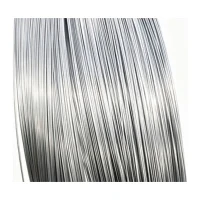


Titanium Rod For 3D Printing
Titanium Rod For 3D Printing is a high-purity feedstock material designed for advanced additive manufacturing processes such as powder production, electron beam melting (EBM), and laser powder bed fusion (LPBF). Produced by China Super Tech Co., Ltd., the rod is manufactured using Vacuum Arc Remelting (VAR) and multiple-stage vacuum degassing to ensure extremely low oxygen, nitrogen, and hydrogen content.

- Product Introduction
Product Introduction
Titanium Rod For 3D Printing is a high-purity feedstock material designed for advanced additive manufacturing processes such as powder production, electron beam melting (EBM), and laser powder bed fusion (LPBF). Produced by China Super Tech Co., Ltd., the rod is manufactured using Vacuum Arc Remelting (VAR) and multiple-stage vacuum degassing to ensure extremely low oxygen, nitrogen, and hydrogen content.
This controlled metallurgy prevents brittle α-phase formation and improves melt stability during atomization, resulting in uniform spherical powder with high flowability. By tightly controlling alloy chemistry and microstructure, the material delivers consistent performance in aerospace, medical implants, and precision industrial parts where mechanical reliability and biocompatibility are critical.
Product Features
1. Ultra-Low Oxygen & Gas Control Metallurgy
Unlike conventional titanium feedstock, our production uses double vacuum melting and high-vacuum degassing. This significantly reduces interstitial elements (O, N, H), which directly improves ductility and prevents cracking during atomization.
2. Stable Microstructure for Powder Consistency
Through controlled solidification rates in VAR processing, the internal grain structure remains uniform. This ensures consistent melting behavior during plasma or gas atomization, producing highly spherical powders.
3. High Purity Alloy Composition Control
Strict raw sponge titanium selection and spectrometric verification ensure alloy deviation is kept within tight industrial standards, which improves repeatability in additive manufacturing batches.
4. Excellent Melt Flow Behavior
Optimized thermal conductivity and controlled impurity levels allow smoother atomization, reducing satellite powder formation and improving yield efficiency in powder production systems.
Product Applications
1.Aerospace structural components (lightweight brackets, engine parts)
2.Medical implants (orthopedic screws, dental frameworks)
3.3D printed precision tooling and molds
4.Automotive high-performance lightweight components
5.Chemical and marine corrosion-resistant parts
Customized Service
China Super Tech Co., Ltd. provides flexible engineering customization to match different additive manufacturing requirements:
1.Alloy grade adjustment (Grade 5, Grade 23, or custom Ti alloys)
2.Diameter control from 30mm to 150mm
3.Oxygen and impurity level tuning for specific powder systems
4.Vacuum melting process optimization based on end-use application
5.Traceability certification (batch-level chemical and process records)
Each customization batch is supported by metallurgical analysis reports and mechanical property validation to ensure repeatability in production environments.
Technical Specifications
|
Item |
Specification |
|
Material Grade |
Ti6Al4V / Grade 5 / Custom Titanium Alloy |
|
Manufacturing Process |
VAR (Vacuum Arc Remelting) + Vacuum Degassing |
|
Diameter Range |
30 mm – 150 mm |
|
Oxygen Content |
≤ 0.13% (customizable lower) |
|
Nitrogen Content |
≤ 0.05% |
|
Hydrogen Content |
≤ 0.015% |
|
Density |
4.43 g/cm³ |
|
Surface Condition |
Polished / Machined / Turned |
|
Application |
Powder atomization for 3D printing |
|
Certification |
ISO / ASTM compliance (on request) |
FAQ
Q1: Why is vacuum melting important for titanium feedstock?
Vacuum melting reduces oxygen, nitrogen, and hydrogen contamination. These elements cause brittleness and inconsistent powder morphology, so removing them improves printing stability.
Q2: Can this material be directly used for 3D printing?
No. It is designed as feedstock for powder production or specialized additive manufacturing processes, not direct filament printing.
Q3: How do you ensure batch consistency?
Each batch is produced under controlled VAR parameters and verified using spectrometric chemical analysis and microstructure inspection.
Q4: What makes your material different from standard titanium rods?
The difference lies in gas control purity, melting uniformity, and strict alloy deviation control, which directly improves powder sphericity and printing performance.
Hot Tags: titanium rod for 3d printing, China titanium rod for 3d printing manufacturers, suppliers, factory, titanium high strength rod, titanium hollow rod, titanium machining rod stock, titanium offshore rod