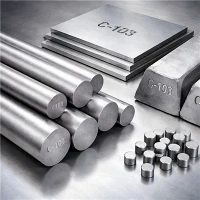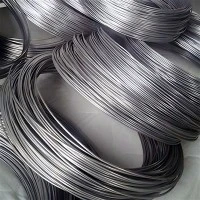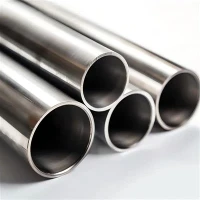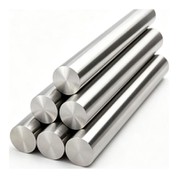


C103 Nb-Hf Alloy Plate
C103 Nb-Hf Alloy Plate is a铌-hafnium alloy sheet supplied by China Super Tech Co., Ltd. The hafnium content is approximately 1%, and its melting point is as high as 2468°C. We produce it using the vacuum arc remelting (VAR) process, which ensures that the hafnium element is evenly distributed within the niobium matrix. This makes the sheet maintain structural stability at temperatures above 1800°C, and it also possesses excellent acid corrosion resistance and high-temperature oxidation resistance. It is an indispensable structural material in extremely high-temperature environments.

- Product Introduction
Product features
1. The hafnium element uniformly strengthens the material, and it does not deform or collapse at high temperatures. Ordinary niobium plates will significantly lose their strength above 1500°C. However, through the VAR vacuum melting process, 1% of hafnium is dispersed as fine carbides on the grain boundaries, effectively pinning dislocations and enabling the C103 Nb-Hf Alloy Plate to maintain an tensile strength of over 400 MPa at 1800°C. This is something that ordinary pure niobium plates cannot achieve.
2. Resistant to acid corrosion, not afraid of strong acid environments
Niobium itself has extremely strong resistance to hydrochloric acid, sulfuric acid, and phosphoric acid. Our plates undergo acid washing and vacuum annealing treatment, resulting in a surface without oxide inclusions. They can remain stable even in boiling sulfuric acid, far superior to ordinary high-temperature alloys.
3. Good welding performance, no cracking during processing
The hafnium content of C103 alloy is controlled within the precise range of 1% - any higher will make it brittle, and any lower will lose its advantage at high temperatures. This ratio was determined through extensive process verification, ensuring that the plates do not produce hot cracks after TIG welding. Customers can directly process and shape them after receiving them.
Product Application
1. Components of the high-temperature section of the aeroengine
The temperature of the engine combustion chamber exceeds 1600°C. Ordinary nickel-based alloys will undergo creep deformation, while the C103 Nb-Hf Alloy Plate, due to the hafnium strengthening mechanism, maintains rigidity within this temperature range and is suitable for use as load-bearing components such as flame tubes and guide vanes.
2. Structural components of nuclear reactors
Nickel has an extremely low absorption cross-section for thermal neutrons, and the controlled neutron absorption property of hafnium makes this combination less prone to brittleness in irradiation environments and ensures stable dimensions, making it suitable for use as internal support structures and auxiliary components of fuel cladding in reactors.
3. Insulation and load-bearing plates for high-temperature vacuum furnaces
There is no oxidation protection in a vacuum furnace, and ordinary metals will rapidly oxidize and fail. Our plates undergo vacuum annealing treatment, have a high surface density, and have a service life more than twice that of molybdenum plates in a 1800°C vacuum environment.
4. Acid-resistant inner linings for chemical equipment
In the production of phosphoric acid and sulfuric acid, equipment is in constant contact with strong acid and high-temperature media. The dual acid and high-temperature resistance characteristics of the C103 plate make it the preferred material for reaction vessel linings and heat exchange pipe walls.
Customized service
China Super Tech Co., Ltd.'s customization capability on the C103 Nb-Hf Alloy Plate is not simply "cutting according to size", but starts from the material level:
1. Precise composition control: Our VAR smelting furnace can control the hafnium content within the range of 0.95% to 1.05%, and make micro-adjustments based on your operating temperature. For high-temperature applications, it is set at the upper limit, while for welding applications, it is set at the lower limit.
2. Flexible thickness: From 0.5mm thin plates to 50mm thick plates, they can all be rolled. Thin plates use multi-pass cold rolling + intermediate annealing to ensure no edge cracking; thick plates use forging + hot rolling to ensure no internal porosity.
3. Provide material certificates with the goods: Each batch comes with a spectral analysis report and a mechanical property test sheet, and the data is traceable.
This full-chain control from smelting to delivery is our core capability that distinguishes us from ordinary traders.
Specifications
|
Parameter |
Specification |
|
Product Name |
C103 Nb-Hf Alloy Plate |
|
Material Grade |
C103 (Nb-Hf-Ti-Zr Alloy) |
|
Chemical Composition |
Nb Balance, Hf 10%, Ti 1%, Zr 0.7% (typical) |
|
Standard |
ASTM B654, AMS 7852 |
|
Density |
8.85 g/cm³ |
|
Melting Point |
2350 ± 50°C |
|
Tensile Strength (RT) |
≥ 420 MPa |
|
Yield Strength (RT) |
≥ 250 MPa |
|
Elongation |
≥ 20% |
|
Elastic Modulus |
100–112 GPa |
|
Thermal Conductivity |
37–42 W/m·K |
|
Operating Temperature |
1200–1400°C |
|
Surface Finish |
Cold Rolled, Polished, Pickled |
|
Thickness Range |
0.5–20 mm |
|
Width Range |
50–1000 mm |
|
Length Range |
100–3000 mm |
|
Flatness |
≤ 2 mm/m |
|
Manufacturing Process |
Vacuum Melting → Forging → Rolling → Annealing |
FAQ
What are the differences between C103 and pure niobium plates? Why is hafnium added?
+
-
After adding 1% hafnium, the high-temperature strength increases by approximately 40%, and the anti-rheological property is significantly enhanced. Pure niobium will rapidly soften above 1500°C, but the C103 Nb-Hf Alloy Plate can still operate stably at 1800°C. This is the reason for the higher cost of adding hafnium.
What is the thinnest it can be made? Will it be prone to cracking?
+
-
The thinnest can be 0.5mm. We use cold rolling and intermediate annealing processes. The reduction amount in each pass is controlled within 15% to avoid cracking due to work hardening. Before delivering the thin plates, we will conduct bending tests to ensure they are usable upon arrival.
How long is the delivery time?
+
-
For regular specifications (thickness ≤ 10mm, standard size), the goods are in stock and can be dispatched within 3 to 5 working days. For non-standard customization, it requires re-production, usually taking 15 to 25 working days. The exact time depends on the thickness and quantity.
Can you provide a proof of the material?
+
-
OK. Each batch of goods comes with a spectral composition report and a mechanical performance test sheet. If third-party testing is required (such as by SGS), please communicate in advance and arrangements can be made.
Hot Tags: c103 nb-hf alloy plate, China c103 nb-hf alloy plate manufacturers, suppliers, factory, niobium aerospace metal, niobium alloy batch machined components, niobium alloy valve components, niobium alloy wire edm components, niobium metal strip, niobium metal tube