




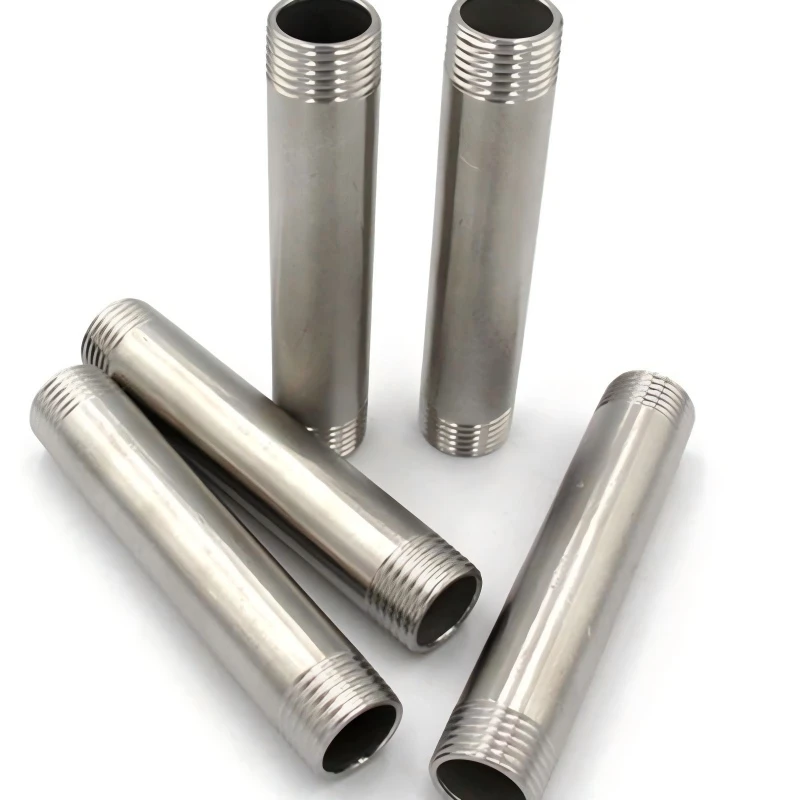
Titanium Forged Components
Titanium forged components are engineered for applications requiring high strength-to-weight ratios, reliable corrosion resistance, and prolonged service life under dynamic mechanical stress. Compared with cast or machined-from-bar alternatives, forged titanium parts feature an unbroken grain flow, improved fatigue strength, and structural integrity.

- Product Introduction
Precision Titanium Forged Components for Industrial Applications
Titanium forged components are engineered for applications requiring high strength-to-weight ratios, reliable corrosion resistance, and prolonged service life under dynamic mechanical stress. Compared with cast or machined-from-bar alternatives, forged titanium parts feature an unbroken grain flow, improved fatigue strength, and structural integrity.
We produce precision custom titanium forgings for plastic injection molding systems, aerospace hardware, medical devices, chemical processing equipment, marine engineering, and automated machinery. Production utilizes certified titanium alloys processed through controlled thermal heating, closed-die or open-die forging, thermal heat treatment, CNC machining, and rigorous non-destructive testing.
Engineering Consultation: Need a custom material review or DFM (Design for Manufacturing) feedback? Contact our engineering team today for a custom quote and technical evaluation within 24 hours.
Technical Advantages of Titanium Forging
Refined Mechanical Strength
Subjecting titanium to plastic deformation under high pressure forces the internal grain structure to conform to the component's geometry.
Eliminates internal microporosity and shrinkage defects typical of castings.
Aligns the metal grain flow along primary stress vectors to maximize tensile strength, yield strength, and impact toughness.
Delivers superior resistance to cyclic loading and mechanical shock in load-bearing structural parts.
High Strength-to-Weight Ratio
Titanium offers exceptional structural efficiency compared to standard engineering metals:
40–45% lighter than equivalent stainless steel components.
Reduces operational inertia in high-speed reciprocating equipment, lowering energy consumption and mechanical wear.
Decreases overall assembly weight in precision automation and mold components.
Corrosion Resistance
Titanium spontaneously forms a tightly adherent, passive titanium dioxide film (TiO₂) on its surface. This oxide layer self-heals instantly in the presence of oxygen, protecting the base metal against aggressive environments:
Marine and saltwater immersion
Concentrated chloride solutions and acidic chemical processing
High-humidity industrial cooling loops
Fatigue Performance and Reliability
Grain refinement during the forging process restricts crack initiation and propagation. This makes titanium forgings ideal for high-cycle dynamic components such as mold clamping links, hydraulic manifolds, and rotating shafts, directly reducing unexpected equipment downtime.
Precision Tolerancing
Our closed-die forging operations are paired with multi-axis CNC machining to achieve tight geometric controls:
• Dimensional tolerance: Up to ±0.01 mm
• Surface roughness: Ra 0.8–3.2 μm
Full Geometric Dimensioning and Tolerancing (GD&T) support
Available Titanium Grades
|
Grade |
Unified Numbering System (UNS) / Designation |
Key Characteristics |
Typical Applications |
|
Grade 2 |
R50400 (Commercially Pure) |
Formable, weldable, high corrosion resistance |
Chemical tanks, marine hardware, piping |
|
Grade 5 |
R56400 (Ti-6Al-4V) |
High tensile strength, excellent fatigue properties |
Aerospace structures, high-load plastic molds, machinery |
|
Grade 7 |
R52400 (Ti-6Al-4V + Pd) |
Enhanced crevice and chemical corrosion resistance |
Aggressive chemical processing equipment |
|
Grade 9 |
R56320 (Ti-3Al-2.5V) |
Medium strength, lightweight, good cold workability |
Hydraulic lines, precision engineering components |
|
Grade 23 |
R56407 (Ti-6Al-4V ELI) |
Extra-low interstitials for fracture toughness |
Surgical implants, orthopedic medical devices |
Standard Production Workflow
Raw Material Verification: Spectroscopic analysis of incoming mill billets.
Billet Preparation: Precision sawing/cutting to exact weight.
Thermal Heating: Induction or gas furnace heating under controlled temperature bands.
Forging Operations: Open-die or closed-die deformation using mechanical or hydraulic presses.
Heat Treatment: Stress relief, solution annealing, or aging cycles tailored to the alloy grade.
CNC Machining: Turning, milling, and drilling to final drawing specifications.
Surface Finishing: Mechanical or chemical conditioning (pickling, passivation, sandblasting, shot peening).
Inspection & Testing: 100% dimensional checks and non-destructive testing (NDT).
Surface Finishing Options
Precision Machined: As-machined finish directly from CNC operations.
Pickled & Passivated: Chemical descaling to remove surface oxides and maximize corrosion resistance.
Sand Blasted / Shot Peened: Increases surface hardness layer and compressive residual stress to boost fatigue limits.
Polished: Mechanical smoothing for aesthetic or hygienic requirements.
Industry Applications
Plastic Injection Molding: Mold inserts, structural backing plates, structural clamps, and high-speed core slides.
Aerospace: Airframe structural fittings, actuator housings, landing gear links, and fasteners.
Medical Equipment: Surgical hand instruments, titanium shell implants, and orthopedic trial components.
Chemical Processing: Pump impellers, valve bodies, heat exchanger flanges, and pressure vessel nozzles.
Marine Engineering: Subsea valve actuators, propeller shaft sleeves, and corrosion-resistant fasteners.
Technical Specifications Summary
|
Parameter |
Specification Range |
|
Available Grades |
Grade 2, Grade 5 (Ti-6Al-4V), Grade 7, Grade 9, Grade 23 (ELI) |
|
Forging Types |
Open-Die Forging, Closed-Die (Impression Die) Forging |
|
Component Weight |
0.1–300 kg |
|
Maximum Diameter |
Up to 1000 mm |
|
Maximum Length |
Up to 3000 mm |
|
Dimensional Tolerance |
Down to ±0.01 mm (via secondary CNC machining) |
|
Surface Roughness |
Ra 0.8–3.2 μm |
|
Applicable Standards |
ASTM B381, ASTM F67, ASTM F136, AMS standards |
|
Accepted CAD Formats |
STEP, STP, IGES, DXF, DWG, PDF |
Quality Assurance & Testing
Each production lot undergoes structured quality checks to verify structural integrity:
Chemical composition confirmation via optical emission spectrometry.
Brinell or Rockwell hardness testing.
Tensile testing (Yield strength, Ultimate Tensile Strength, Elongation).
Ultrasonic Testing (UT): Internal volumetric defect inspection per AMS standards.
Dye Penetrant Inspection (PT): Surface-breaking flaw detection.
Certified in accordance with EN 10204 3.1 documentation requirements.
FAQ
Q: What titanium grades do you offer for forged components?
A: We commonly manufacture Grade 2, Grade 5 (Ti-6Al-4V), Grade 7, Grade 9, and Grade 23 titanium forgings. Other titanium alloys can also be supplied based on project requirements.
Q: What are the advantages of forged titanium components over cast parts?
A: Forged titanium components have a denser grain structure, fewer internal defects, higher fatigue strength, better impact resistance, and longer service life than cast components, making them ideal for high-load and safety-critical applications.
Q: Can you manufacture according to our drawings?
A: Yes. We produce fully customized titanium forged components based on customer drawings, samples, or technical specifications. We support both prototype development and mass production.
Q: What drawing formats do you accept?
A: We accept STEP, STP, IGES, DXF, DWG, PDF, and other standard CAD formats.
Q: What inspection reports can you provide?
A: Depending on customer requirements, we can provide material certificates, chemical composition reports, dimensional inspection reports, hardness test reports, tensile test reports, ultrasonic testing (UT), dye penetrant testing (PT), and EN 10204 3.1 certificates.
Q: What is your typical production lead time?
A: Lead time depends on part size, complexity, and order quantity. Prototype orders generally require 2–4 weeks, while standard production orders are typically completed within 4–8 weeks after technical confirmation.
Hot Tags: titanium forged components, China titanium forged components manufacturers, suppliers, factory, Tungsten Copper Alloy Block


